

By the night of November 3, it was becoming pretty clear that Democrats were going to take control of the House. NBC News had already projected a Democratic victory, and Hakeem Jeffries was celebrating. For most people following the election, there wasn’t much doubt about which party had won.
But something interesting happened on Manifold. One market asked when the Associated Press (AP) would call control of the House. Before trading closed, the probability of an AP call before midnight on election night had reached 75%. Despite that confidence, the market ended up resolving to November 4.

Traders had correctly anticipated the election outcome, but the timing of the AP’s announcement caught them off guard. The call came around 1:30 a.m. Eastern, just past the market’s midnight deadline. Even though Democrats had won the House by a comfortable margin, those extra 90 minutes were enough to change how the market resolved.
The midnight deadline was listed in the answer itself, so traders likely knew what they were betting on. Where they seem to have been off was in how soon the AP would call the race.
What the title says vs. what the rules say
In Forecasting a Third Term, Sahaj discussed a similar idea with markets about whether Trump would attempt a third term. The question seems straightforward at first, but the rules require something more specific to happen. A formal action, such as an FEC filing, a legal challenge, or an attempt to get on a ballot, would count as YES. A Truth Social post about running for a third term wouldn’t be enough.
This distinction matters when interpreting the roughly 18% probability the market showed at the time (it’s at 6% as of this writing). That figure reflects the likelihood of someone taking a concrete step toward challenging the 22nd Amendment, which is a narrower outcome than the market title might initially suggest.
The same idea applies to election markets. A market’s title gives a general sense of the question, but it can usually be read in more than one way, and the resolution criteria settle on one of them. That’s what allows the market to resolve clearly. It also means two markets with similar titles can end up asking different things, which can make it interesting to compare them, as the midterm markets show.
Two markets, one night
Two small markets on Manifold asked similar questions about whether control of Congress would be known by the end of election night. Their deadlines and requirements, however, were different.
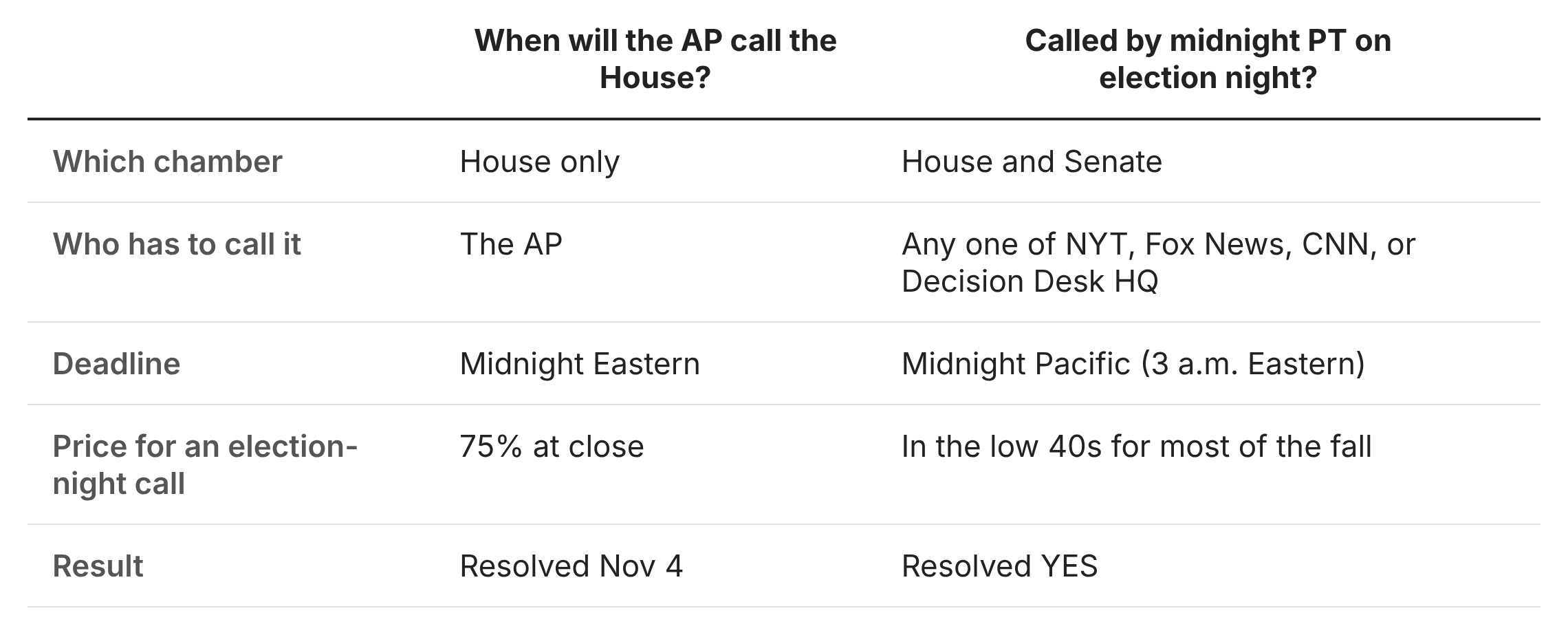
When will the AP call the House? and Called by midnight PT on election night?

Looking at these two markets, I would have expected the second one to be harder to resolve YES, since it required both the House and Senate to be called. The Senate was expected to be the closer race, so if you had asked me in October, I probably would have focused more on that requirement.
As it turned out, Democrats performed well enough that the Senate was called relatively early. By 11:54 p.m. Eastern, the AP’s live blog had already reported the Senate call, and several major networks had projected a Democratic victory in the House that night. The AP’s House call came later, at around 1:30 a.m. Eastern.
Timing and sourcing explain the two outcomes. The first market required an AP call before midnight Eastern, while the second accepted calls from four different news outlets and allowed until midnight Pacific, giving it three additional hours. The AP also tends to be more cautious when calling elections, waiting until there is no realistic path for the trailing side to catch up. For the first market, this made the timing of the AP’s announcement especially important.
The market opened with every date at 20%, the default for a market with five possible dates rather than a forecast. Within a day, a single trader pushed election night to 54%, and by the time trading closed, traders had it at 75%.
These were small markets, with only 5 and 11 traders, so I wouldn’t put too much weight on the exact probabilities. The comparison is still useful because it shows how two questions about essentially the same election can produce different results depending on their rules.
The problems that didn’t happen
A much bigger market, Who controls Congress after the 2026 Midterms?, had 259 traders and a more detailed set of rules. Control of the House was defined as holding a majority of seats, while the Senate required either a majority or a 50-50 split with the vice president breaking the tie. If control was unclear, the market would use the party of the first elected Speaker or Senate Majority Leader to determine the outcome.
The market also required the AP, Fox News, and NBC to call both chambers before resolving. In cases where the outlets disagreed, official certification would determine the result.
Some traders raised questions about situations the rules might not fully address. One asked what would happen if Democrats won the House but Speaker Johnson refused to seat them. Another wanted to know whether an independent Speaker would cause the market to resolve to “Other.” These were fairly specific scenarios, but they showed that at least some participants were thinking beyond the most likely election outcome.
Neither situation occurred, and the market resolved to Democrats Sweep on November 4. Senate races in Mississippi and Alaska remained uncalled for several days afterward, although their results wouldn’t have changed which party controlled the chamber.
The additional rules ended up being unnecessary for this election, but a closer race could have made them much more relevant. In 2022, for example, the AP took eight days to call control of the House. If the 2026 results had been similarly close or disputed, traders would have needed to pay much more attention to the market’s fallback conditions.
Knowing what you’re forecasting
After comparing these markets, I think the main takeaway is that the rules decide what you’re actually forecasting. The two markets were about the same election, but one depended on how quickly the AP would make its call, while the other depended on whether any of four outlets would call both chambers before 3 a.m. Eastern. Knowing which question you’re trading on can also help you figure out what to watch. In the AP market, for example, the House results mattered less than how long the AP usually waits before making a call, and a trader paying attention to that might have seen 75% as too high.
There are a few things I would pay attention to:
Who determines the outcome? Some markets rely on a single news outlet, while others accept calls from multiple sources. It’s worth checking which sources count and how they make their decisions.
What is the deadline? Both the date and time zone matter, especially for events that could extend past midnight. In the AP market, missing the deadline by about 90 minutes was enough to change the result. In the AP market, missing the deadline by about 90 minutes was enough to change the result.
What counts? A news projection, official certification, legal filing, or another specific action can all represent different stages of the same event.
What happens if the outcome is unclear? Markets sometimes include additional conditions for ties, disputes, or delays. Understanding those conditions can be useful when the result is close.
Traders were right that Democrats would win the House, but the market was asking something narrower than that. Getting the election right didn’t necessarily mean getting the market right, and in this case the difference came down to the resolution criteria.
Sources
Forecasting a Third Term, Above the Fold
How Democrats Flipped Congress, U.S. News
Who will control Congress after the 2026 midterms?, AP via Fox 2