

The 22nd Amendment was ratified in 1951 because Congress was afraid Franklin Roosevelt’s coalition would keep electing him indefinitely. Roosevelt had won four consecutive presidential elections, and after his death in 1945, the Republican majority in the 80th Congress moved quickly to ensure it couldn’t happen again. The amendment was written specifically in the shadow of a dominant electoral figure with a loyal base and no obvious successor. No court has ever had to rule on whether it means what it plainly says, because until now, no president has been in a position to seriously contemplate forcing that question.
Trump is the first. Since the amendment’s ratification, he’s the first president to publicly entertain whether it actually forecloses a third term, and that entertaining has taken a specific form: oscillating between positions with enough frequency that tracking his actual view has become genuinely difficult. On August 12, reporters at Joint Base Andrews asked if he was planning to run again. “I’d love to run, but the law is very strong,” he said. Three days later, he posted an AI-generated image of himself in a “Trump 2028” hat to Truth Social, captioned “We are going to win.”
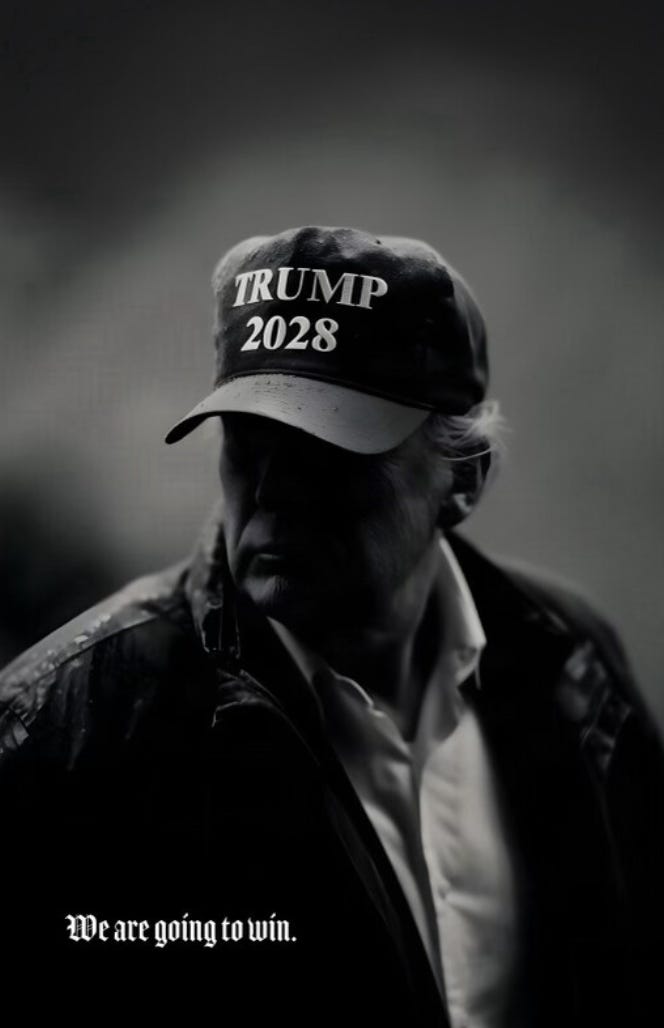
At the Coast Guard Academy commencement in May, while discussing icebreaker ships scheduled to arrive in 2028, he noted: “I’m going to be here in ‘28. Maybe I’ll be here in ‘32 too. I don’t know.” In March 2025, to NBC’s Kristen Welker: “I’m not joking. There are methods.” Two months later, same interviewer: “I’ll be an eight-year president.” In October 2025, on Air Force One to South Korea, the day after Speaker Johnson said publicly there was no constitutional path: “If you read it, it’s pretty clear. I’m not allowed to run. It’s too bad.” The next sentence: “Based on what I read, I guess I’m not allowed to run. So we’ll see what happens.”
The question of whether any of this is sincere tends to generate more heat than light. It assumes a stable private intention being concealed by public performance, but Trump’s political behaviour has consistently operated without that gap. The third term talk has produced real political consequences regardless of what’s behind it: Vance can’t consolidate the succession, no potential 2028 candidate can safely emerge without appearing to presume on a decision Trump hasn’t made, every Republican with White House ambitions performs loyalty to someone who may be their opponent.
The Vance situation tells us more. Trump has declined to endorse his vice president as a 2028 successor, called it “too early,” pointed to both Vance and Rubio as a “potential ticket,” and told reporters who asked about Vance simply: “I’m going to be here in ‘28.” A straw poll at the Western Conservative Summit in Colorado earlier this month gave Rubio 57% and Vance 21% among 500-odd attendees. The party is starting to move past the ambiguity even as Trump refuses to. What happens to the utility of that ambiguity when the party has effectively chosen? Traders give Vance a 19% shot and Rubio 12%.


Markers cluster on whether Trump formally attempts a third-term, hovering between at around 18%. They resolve YES on specific, concrete acts: an FEC filing, a legal challenge, a formal attempt to get on a ballot, and don’t do the same for Truth Social posts. So what they’re measuring is narrower than “does Trump want to run again” and whether the man simply says he’s in the race (for which there’s also a market) - they’re measuring whether someone forces the 22nd Amendment question into an adversarial legal setting before 2028. For that question specifically, 1 in 5 seems reasonable, possibly conservative. The legal infrastructure to challenge it exists (at least according to his supporters). The constitutional question hasn’t been settled by any court. The Republican legal ecosystem that produced Trump v. Anderson, which reached the Supreme Court on an unprecedented constitutional question and was resolved unanimously in Trump’s favour, is not philosophically opposed to testing limits that look settled from the outside. A formal challenge wouldn’t necessarily succeed, but the conditions for one are closer to present than the coverage of Trump’s stated positions would suggest.


At CPAC in February 2025, a group called the Third Term Project unveiled a banner depicting Trump as Julius Caesar. Shane Trejo, the campaign lead, told reporters: “Trump is the Caesar figure that America has needed. Trump is the Napoleonic figure that has emerged to lead our country out of perdition and into greatness.” He added that he thought it was “great optics.” Caesar crossed the Rubicon, declared himself dictator perpetuo, and was stabbed 23 times on the Ides of March by members of the Roman Senate. The Ogles amendment, which the Third Term Project exists to support, changes “twice” to “two consecutive terms,” a narrow intervention designed specifically for Trump’s non-consecutive structure.
Finally, if you want to think about forecasting in person: The Overhang is a two day conference on forecasting and its implications, September 19-20th in Washington, DC. Inspired by Manifest, and run by the team who put on Manifest X DC last year, sessions for its 150 attendees will call on the community's playfulness, ambition, whimsy, and skill. The theme of this weekend is Forecasting, broadly construed, whether that’s prediction markets, calibration, your own personal growth, or just talking about exciting new problems we’ll solve in the world to come.
Sign up at: theoverhang.ai
Happy Forecasting!
- Above the Fold
Sounds like the Trump avoiding endorsing Vance is at least partly that people in the white house prefer Rubio (but it'd be awkward to openly oppose a sitting VP), rather than a realistic pro-third term Trump position.