

On Tuesday, Alaskans will open their ballots and find two Dan Sullivans running for Senate. Only one of them is the senator. The other, according to a New York Times investigation, was recruited with help from Democratic operatives, who deny it. It’s an unusual race in a midterm where the polls and the markets mostly point the same way: against the party in power.
Democrats lead the generic congressional ballot by 6 points in the latest YouGov/Economist poll (October 23-26, 2026), but by 11 points among likely voters. The gap largely reflects enthusiasm: 88% of Democrats polled were classified as likely voters, whilst only 81% of Republicans were.
The Trump coalition includes more low-propensity voters who show up only in presidential years, along with some who are disappointed in the administration. In the October 2026 poll, 95% of Harris 2024 voters say they made the right choice in 2024, compared with only 86% of Trump 2024 voters. If Republicans can bring enough of them back, they could hold some House seats in tight races, but keeping control of the House looks very unlikely. Traders give Republicans only a 4% chance.
One of the biggest factors hurting Republicans is the economy. The October 2026 YouGov poll shows 59% of voters think the economy is getting worse. That’s a big contrast to the 2018 midterms, when a late October YouGov/Economist poll found only 23% of voters thought so. In 2018, Democrats won 235 House seats and the House popular vote by 8.6 points. Given opinions on Trump and the economy, this year’s margin could be even bigger.
The direction of the country question tells a similar story. Before the 2018 midterms, 49% of voters said the country was on the wrong track. In a February 2025 YouGov/Economist poll after Trump had become President again, it was 50%. In the latest October poll it’s 72%.
Strength of feeling about Trump has also shifted. In February 2025, 30% of voters strongly approved of him and 37% strongly disapproved. Now 22% strongly approve and 50% strongly disapprove, a swing from -7 to -28.
One constant reminder voters get is gas prices, which currently average $4.26 nationwide, up from $3.12 on Trump’s inauguration day. Traders expect it to stay at roughly that level on Election Day.
The Senate

Republican chances in the Senate have fallen sharply this year. Traders now give them only a 26% chance of winning 50 or more seats (enough for control with the VP tiebreaker) in Tuesday’s election.
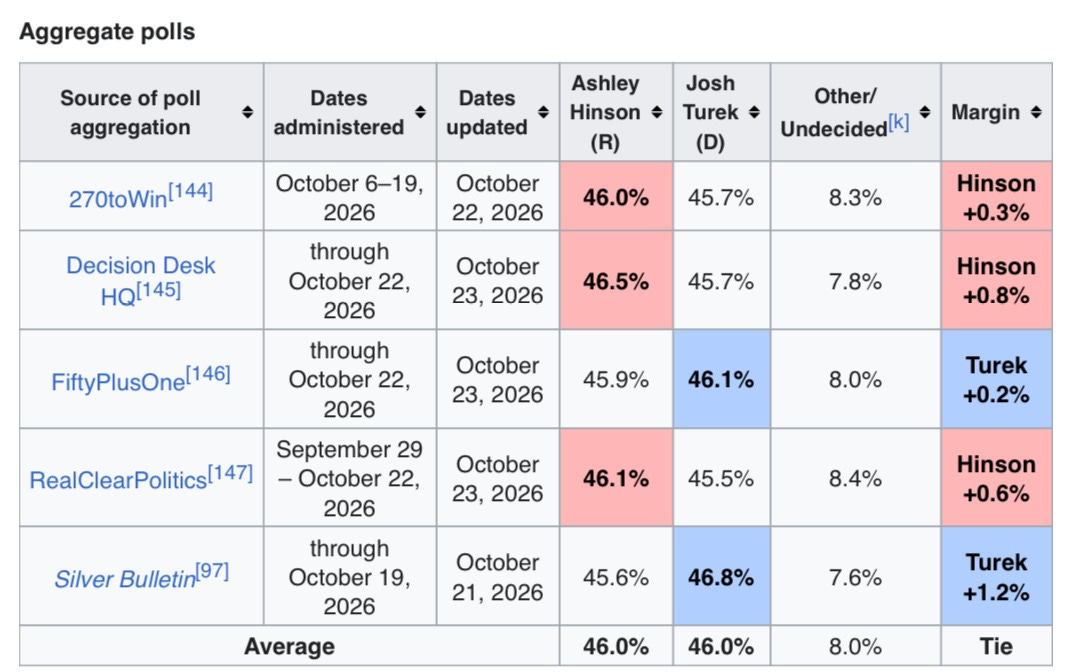
Iowa is one of two Senate races Manifold currently rates a toss-up on the election dashboard. Traders give Republican Ashley Hinson a 57% chance of beating Democrat Josh Turek, even though the polls are essentially tied: the average across five aggregators is 46.0% each, with individual aggregators ranging from Hinson +0.8 to Turek +1.2. Iowa is also the favourite, at 18%, in the market for which Senate race will have the smallest margin of victory.
Democrats currently hold 47 Senate seats, including independents who caucus with them. They need 51 for a majority, since Republicans hold the VP tiebreaker at 50-50. On Manifold, 52 seats is the most likely outcome, but at just 14% it is far from certain. A 52-seat result would give Democrats a one-seat buffer if Fetterman or another senator left the party or refused to back a particular bill.

Alaska
In the Alaska Senate race, traders give incumbent Republican Dan Sullivan only a 32% chance of holding his seat against Democrat Mary Peltola.
The New York Times reported on Wednesday that aides to Peltola’s campaign and staffers at the Democratic Senatorial Campaign Committee worked to encourage spoiler candidates to enter the race, to try to take votes from the incumbent Republican. According to the Times, Peltola’s former campaign manager said Peltola wasn’t directly involved but was aware of it. Peltola’s campaign and the DSCC deny any involvement, and the former campaign manager has since tried to retract her statements to the Times.
One of those candidates is also named Dan Sullivan. He filed to run as a Republican. Election officials viewed that as bad faith and tried to remove him from the ballot. After the Alaska Supreme Court put him back on, they listed him under his registered voting name, Daniel J. Sullivan Jr., with no party label to avoid confusion with the incumbent, who is marked “(Incumbent)” on the ballot. Records show the spoiler Sullivan donated to Peltola’s House campaigns in 2022 and 2024 and to an Illinois left-wing House candidate in 2025, which raises doubts about his attempt to file as a Republican.

How the candidates appear on the ballot. Republican Gerald Heikes is also running.
Sullivan Jr. took 2.5% and finished third in the open primary, and traders give him an 87% chance of finishing third again. On Truth Social, Trump has called the ballot a “TOTAL DEMOCRAT SCAM” meant to confuse voters.
Early voting is strong: 58,168 votes had been cast as of Tuesday afternoon, October 27, about 22% of the 267,047 cast in the 2022 midterms. All of those votes were in before the Times story came out.
In the Alaska governor’s race, Republican Senator Lisa Murkowski has crossed party lines to endorse Democrat Jonathan Kreiss-Tomkins, who traders give a 90% chance of winning. Republicans are hurt by the open primary and ranked-choice voting. One Democrat and three Republicans advanced from the primary. Trump endorsed Bernadette Wilson, but the outgoing governor hasn’t endorsed anyone and has told voters to rank all three Republicans. Ballots that don’t rank all three could be exhausted, and a split party fighting itself makes it hard for Republicans to win.
Trump recently called Murkowski the worst Republican senator by far and a disgrace to her state, and said she was only reelected in 2022 because of “corrupt” ranked-choice voting. Traders give her a 32% chance of leaving the Republican Party before 2029.
Alaskans are also voting on a measure to repeal ranked-choice voting and restore party primaries. Trump has endorsed it, and Elon Musk is one of its funders, but traders give it only a 33% chance of passing. A very similar measure failed in 2024 by 743 votes (0.23%). If it passes, Murkowski would be vulnerable to a primary challenge in 2028, because she relies on crossover Democratic votes. She won in 2010 as a write-in candidate, and in 2022 she picked up about 20k votes from the eliminated Democrat, against about 2k for her Republican opponent.
So on Tuesday, watch Alaska twice: once for which Dan Sullivan voters pick, and once for whether they keep the system that made that question possible.
