

The Man With The Armada
Trump announced on January 13 that “help is on its way” to Iranian protesters. Forty-eight hours later, he told reporters “the killing has stopped.” This week he posted that “a massive Armada is heading to Iran” and it’s “ready, willing, and able to rapidly fulfil its mission, with speed and violence, if necessary.”

The armada in question is the USS Abraham Lincoln carrier group, which was still 5-7 days away when Trump made these threats.
This is Maximum Pressure 2.0, which looks remarkably like Maximum Pressure 1.0 except Trump’s already used most of his good lines. He’s threatened oil exports to zero (they’re at 1.5M barrels/day, mostly to China). He’s imposed 1,500+ sanctions. He’s even bombed Iran’s nuclear sites already (June 2025’s Operation Midnight Hammer).
When you end up crossing the red lines you yourself established, new threats tend to have a certain quality problem.
Odds for US strikes targeting areas in Iran by February hover around 40%, and 60-70% for until the end of June.


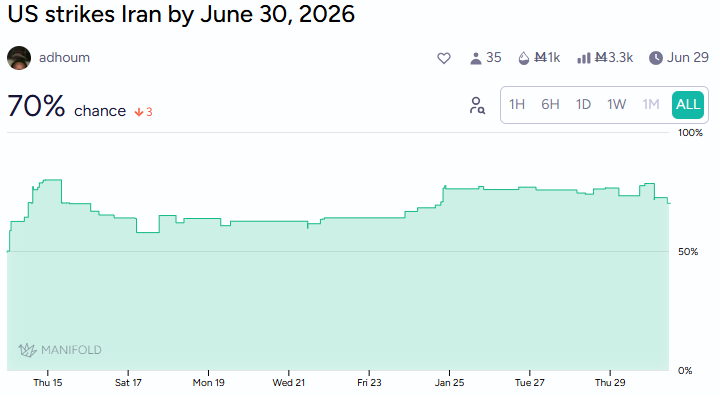
These aren’t crazy numbers given Trump bombed them seven months ago, but they’re also pricing in the uncomfortable reality that threatening to bomb a country when you’ve already bombed them has diminishing returns.
The Trump administration evacuated nonessential personnel from Qatar’s Al Udeid Air Base, which would be the staging ground for any strikes. Whether this is actual preparation or performance art remains unclear.
Trump’s pitch is that Iran’s “looking at FREEDOM, perhaps like never before” and the USA “stands ready to help.” Iran’s pitch back is that their armed forces have “fingers on the trigger” to respond to any aggression. Both sides are now competing to see who can write more in ALL CAPS on social media while their actual military capabilities remain unchanged.
Waiting in Maryland
Khamenei’s 86. He’s been Supreme Leader for 36 years.
Markets give around 50% odds he’s out by 2026, and 33% he’s out by June.


There’s no designated successor because Khamenei designed it that way. The Assembly of Experts technically selects the next Supreme Leader, but the Assembly is composed of clerics Khamenei appointed. Internal succession would likely mean another senior cleric maintaining the status quo, or an IRGC takeover in a crisis.
Reza Pahlavi left Iran in 1978 before the Islamic Revolution. He’s been in exile for 48 years, based in Maryland. He’s 65 now. Markets give 31% odds he enters Iran in 2026.

Protesters in some cities are chanting “Javid Shah” (Long Live the King) and “This Is the Final Battle / Pahlavi Will Return.” Whether this represents genuine monarchist sentiment or nostalgia for pre-1979 Iran is unclear.
A 2023 poll by an Netherlands-based research institute found 81% of Iranians reject the Islamic Republic and would prefer a democratic government.
Pahlavi told U.S. House members in June 2025 that he “does not seek power” but rather wants to lead Iranians down a “road of peace and democratic transition.” Markets give 25% odds he leads the government a year after a hypothetical fall of the Islamic regime.

The opposition has no centralized leadership. Diaspora opposition groups are more polarized than they’ve been in years. Pahlavi’s stance during the 2025 Israel-Iran war drew criticism from other opposition figures, with some calling him a “traitor.”
The succession markets are pricing two different futures: internal regime continuity and Pahlavi entering the country. Both scenarios require Khamenei’s exit, but they’re mutually exclusive outcomes.
Counting in the Dark
Iran shut down internet access on January 8. This is the most comprehensive blackout in the country’s history. Without internet, without independent journalists, everyone’s guessing at casualty figures.
Official Iranian government count: 3,117 dead (2,447 civilians and security forces, the rest categorized as “terrorists”).
Leaked Ministry of Health documents published by Time: As many as 30,000 on January 8-9 alone.
The gap between these numbers is the difference between a brutal crackdown and a massacre. Trump keeps referencing “very important sources” in Tehran. Either he has genuine intelligence or he’s making confident statements based on incomplete information (which he absolutely does not have a history of doing).

The Bazaari Problem
The rial hit a record low of 1,500,000 rials to the US dollar last Tuesday. Food prices are up 72% year-over-year. Iran’s under snapback sanctions related to its nuclear program, plus Trump’s Maximum Pressure 2.0, plus 25% tariffs threatened on any country doing business with Tehran.

Previous protest cycles (2022, 2019, 2009) happened during economic decline. This is different because the economic foundation is collapsing. The bazaaris (the merchant class who helped make the 1979 revolution) are closing shops in solidarity with protesters. When the people who normally profit from regime connections start joining protests, something structural has changed.
Markets give around 34% odds the Islamic Republic falls in 2026. For context, this market sat at effectively 0% for 2025 until December. The 2026 number is the highest regime-change probability priced since 1979.

The regime has survived protests before, but the economic fundamentals are new territory. The reformist government offered direct cash handouts of $7 per month to address economic grievances. This represents either misunderstanding of inflation or desperation.
The Historical Pattern
Markets give favourable odds protests get suppressed. This is the historically informed position. 2022: suppressed. 2019: suppressed. 2009: suppressed. The pattern holds across decades.
The regime has the IRGC intact. They have imported militias. They have a security apparatus that’s practiced protest suppression for 45 years. They’ve demonstrated willingness to kill thousands. Markets understand this.
The simple scale of unrest is different this time. While I’m sure that’s what was said all the other times as well, the combination of uncertainties and disruption is paving way for a very real shot of regime change.
We’re seeing: the complete crash of the rial, bazaaris joining, regional proxies decimated, Khamenei’s age creating succession uncertainty, Trump’s demonstrated willingness to bomb (along with all the uncertainty his presence creates anyway), and protests that started economic but became anti-regime.
What’s the same: no organized opposition leadership, IRGC still functional, most of the population not actively protesting, and the reality that overthrowing an entrenched theocracy with modern security forces is difficult.
The opposition needs Trump to follow through, economic pressure to break the middle class, IRGC defections, and Khamenei’s succession crisis to create an opening. That’s several contingencies. The regime’s approach is what they’ve always done: brutal suppression, wait for exhaustion, blame foreign interference, rely on the fact that revolutionary movements require more than social media and diaspora coordination.
Happy Forecasting!
-Above the Fold
Bleak but fair summary. It really is a tragedy though. One hopes that this poor country does get a better future and fast, but the odds of more misery are, sadly, fairly high.