

“I agree with Dario that we need to pace the frontier,” Sam Altman posted on September 12, the same day Dario Amodei, Anthropic’s chief executive, published an essay arguing that the AI industry needs to slow the pace at which its models get more capable. Elon Musk, who has spent a large part of the past two years suing Altman, said in three words, “Dario is right.”
Nearly two months later, the market on which models launch this month has already resolved YES for Claude’s Fable and Gemini’s 4 Carbon, with OpenAI’s GPT-6.2 Sol (among others) sitting at 94%.

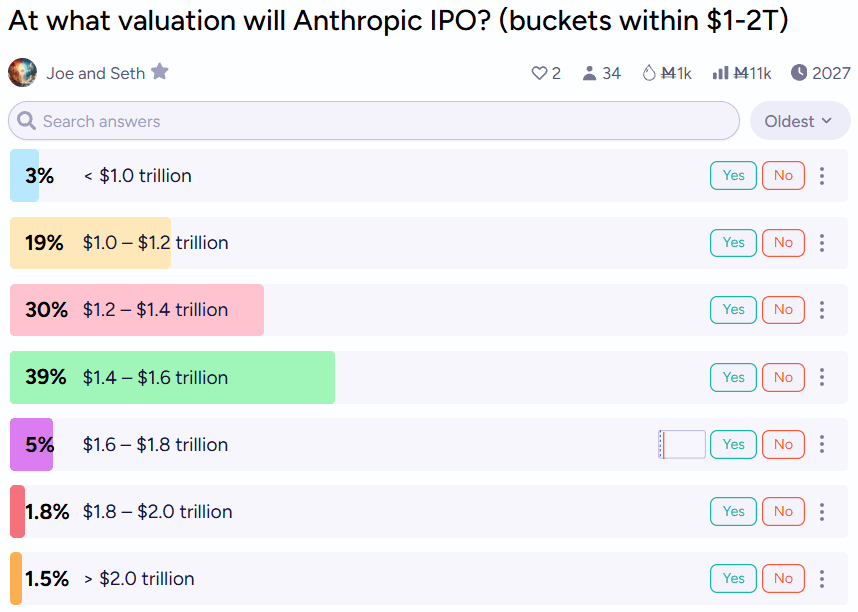
Therein lies the inherent problem with any sort of slowdown. Regardless of how beneficial its effects may be on humanity, nobody wants to go first while everyone else keeps shipping. When one (sort of) did arrive last week, it came from public intention and votes rather than the labs themselves, and it landed in the same stretch as Anthropic wanting to IPO for somewhere north of $1 trillion. Traders put the most likely IPO valuation at $1.4–1.6 trillion, a figure a little above the range Anthropic just set this week, which works out roughly at $1.2-1.4 trillion. D

Read on for more about the unplanned but timely slowdown, what Anthropic is pitching, what its pricing says, and whether traders believe any of it adds up to a bubble.
The Slowdown
On election night, Jensen Huang threw a party for artificial intelligence executives and tech leaders at the San Francisco Opera House. Attendees were dressed up for a performance of “The Marriage of Figaro,” but the atmosphere quickly grew sour as local election results began rolling in. By Wednesday morning, the WSJ reported OpenAI’s senior leadership was already discussing whether to reset its data centre plans for 2027. Musk, meanwhile, was posting that “data centers in space” were “looking pretty appealing right now.”
The source of their worry was mostly further down the ballot, where a two-thirds majority isn’t needed to get anything done. Gina Hinojosa beat Greg Abbott in Texas after promising to “issue a moratorium — a ban —on all data centre approvals.” Wells Fargo estimates that Texas accounts for 27% of all planned data centre capacity in the United States. Measures restricting the operation of data centres have passed in 44 of the 45 local contests so far, and Goldman Sachs put the share of planned capacity sitting in states likely to add restrictions at 45%. A governor can slow down a permit without asking Congress.
Wall Street, to be fair, took a little longer to get there. Last Wednesday, the Dow rose 1569 points, to close at 53,356, its best post-midterm day in 44 years, on the comfortable assumption that a Democratic House and Senate with a Republican president would make any major policy changes challenging. On Thursday, the Nasdaq fell 5.5%, with companies like Nvidia and AMD losing 9.3% and 17.3%, respectively. Nearly $2.5 trillion came off the Nasdaq by the close, and the popular explanation is that Democratic announcements led to the market falling on its face.
There…are tweets, admittedly: Rep. Yassamin Ansari did post on Wednesday that “top of the Democratic agenda on day 1 needs to be a pause on advanced AI development,” which was followed by Senator Bernie Sanders also announcing a “National data center moratorium now.” But Ansari posted on the day the market went up, and Hakeem Jeffries, who will now actually be running the House, said over the summer that a moratorium was “not a position that I’ve articulated at this point” (so not, strictly speaking, a no).
The industry has come out with a round of grandstanding goodwill. OpenAI just published a pledge to shield local residents from higher power bills, along with $4.8 million for free school meals in Georgia, where one of its sites is planned for construction. Meta President & Vice Chairman Dina Powell McCormick, speaking at the WSJ Tech conference, said, “I think it’s going to be harder,” when speaking on launching new U.S. data centre projects.
Sanders and Rep. Greg Casar even want to go a whole lot further. Their Ban Artificial Superintelligence Act would pause development of any model trained with more than 10^25 operations, a threshold that nearly every major model on the market comfortably clears. Traders currently give the Act an 18% chance of becoming law by 2027.

While we may see more push for such policy soon, I’d still be largely skeptical, as the bill would require Trump’s signature, a man who has backed the industry at every turn.
Anthropic’s Pitch
Anthropic filed to go public on October 26, and the growth in the filing is quite something. Revenue sat at $41 million in 2023, rising to an astonishing $4.6 billion last year. And in the three months to September, revenue was $17 billion.
The amended filing, however, which came out on November 2, is slightly less flattering. Revenue grew by $5.4 billion between Q2 and Q3, a remarkable number in itself, but a step down from the $6.8 billion Anthropic added the quarter before. The company also swung back to a $567 million operating loss, one quarter after its first operating profit. According to the filing, that was because it had to rent $5 billion of extra computing power at short notice, which “currently costs significantly more” than its long-term deals, meaning its commitments for computing power and infrastructure now total $895 billion. The second amendment from November 10 also filled in October, revealing quite a good month. At October’s pace, Anthropic would bring in $81 billion over a full year, up $10 billion from September.
The more revealing part of the prospectus is the risk factors, which run nearly a third of the entire document. Anthropic tells prospective shareholders that AI could pose “catastrophic or existential risks to humanity,” and that decisions to “moderate the pace of AI development, delay or restrict the release of models or features” may not maximize the value of their shares. It also notes that proposed US legislation contemplates “potential nationalization, mandatory shutdown, or discontinuation requirements for frontier AI systems,” and that moratoriums “could delay or prevent the construction or expansion of facilities.” It also, fairly quietly, mentions that Anthropic “recently chose to delay pre-training a new frontier base model for more than a month,” although the given reason is one of security, rather than pacing.
However, not everyone believes warnings like these come free. Over the summer, Gavin Baker, who runs Atreides Management, made a claim on the All-In podcast that Anthropic’s Sholto Douglas called “completely false.” Baker replied: “Dario’s messaging has been massively helpful to efforts to ban datacenters here in America.” At the time, it sounded like a dig, but it’s aged well since the election.
To be fair to Amodei, Anthropic is the only lab that has put any of this into writing, and a month’s delay is more than anyone else has explicitly admitted to. But a month for “security” is a long way from pacing the frontier, and no lab has offered to go first on the real thing.
The Price
Before the filing, the number was floated to be as high as $2 trillion. Last month, this number was reported to have fallen to around $1.5 trillion. On November 5, three large investors told the WSJ that the $1.5 trillion figure would probably have to come down. One even thought it could end up “closer to $1 trillion,” not far above the $965 billion Anthropic was valued at privately in May. Another raised the idea of postponing altogether.
The offering itself, expected to raise up to $100 billion, may shrink to $80 billion. Keith Lerner at Truist said, “We are now seeing something of a buyers' strike in tech.”
That strike lasted about five days, with Anthropic, on November 10, setting a range of $70-78 a share, raising about $64.4 billion, with another $26 billion being from Google, Nvidia, and others, being popularly described as “feeding themselves money”. By November 11, Bloomberg reported that Anthropic’s order book was “multiple times oversubscribed,” and the latest reports are now putting it at 6x. It is expected to price on November 18 and start trading the day after.
Traders are more restrained here. They give 17% odds (down from a peak of 77%) that Anthropic IPOs this year and closes its first day above $1.8 trillion, and go as low as 9.5% on closing above $2 trillion.


The Bubble
A valuation that assumes nobody slows it down is essentially the bubble question in a nutshell, and there are quite a few markets testing this.
One market simply asks whether the AI bubble pops in 2026. It resolves on whether outlets end up calling what happened a burst or a crash, rather than on any particular fall in prices. It recently touched 18% after the election before already drifting back to 9%.

Another market asked which AI companies will fall more than 60% from their peak, already resolving Yes for a few like Oracle, SanDisk, Cerebras, CoreWeave, and more.
The longer-term market, whether there will be an AI bubble at all before 2030, currently stands at 68%. Traders do seem to think that this is probably a bubble, just not one that bursts any time in the immediate future.

Before anything is priced, Nvidia reports earnings on November 17, against its own guidance of about $108 billion in revenue. It will be Nvidia’s first set of results since Jensen Huang resigned on Thursday (piece on the drama there soon), and it has just agreed to put $10 billion into Anthropic’s placement. That report will probably say more about current AI demand than any prospectus can. The market on whether Anthropic is trading on Nasdaq by the close on November 20 now sits at 93%.
Happy Forecasting!
- Above the Fold