

The Greatest Scoop In History
On Friday afternoon, Trump was at a Whataburger in Corpus Christi, declaring “hamburgers for everyone” and leaving with a bag bearing order number 47. A reporter asked how close he was to making a decision on Iran. “I’d rather not tell you,” he said. “Otherwise you’d have the greatest exclusive in history.” We now know he was being literal. Nine hours later, from Mar-a-Lago, he announced the start of a major attack.
It was, notably, also from Mar-a-Lago that he’d ordered the toppling of Nicolás Maduro in January. The weekend getaway apparently comes with options.
This also wasn’t a last-minute call, like many are speculating. An Israeli security official told Reuters the operation had been planned for months, the launch date locked in weeks ago. Which makes the diplomacy running in parallel somewhat interesting. Oman’s Foreign Minister announced a “breakthrough” with Iran just the day before the strikes, describing peace as “within reach.” Iran had apparently agreed to halt uranium stockpiling and allow full IAEA verification. Twelve hours later, the Supreme Leader’s compound was rubble.
Whether Iran was negotiating in good faith while the US had already committed to attacking, or whether the US was negotiating in good faith while Israel had already committed to attacking, is a question that will occupy historians and at least one Omani diplomat for some time.
What the markets had already worked out was that the direction wasn’t going to be a deal. The strike-by-June market had been sitting at 60-70%. The strike-by-February-28 market specifically sat at 17% days before: low, but not zero, which is the honest read of how surprising this actually was.


Six Polymarket accounts correctly positioned on the specific date and walked away with around $1.2 million.
Khamenei’s Theory of the Game
To understand what happened Saturday, it helps to understand what Iran, at least thought, it was doing.
After the June 2025 ceasefire (the 12-day war that ended with Israel having struck nuclear facilities and Iran having hit a US base in Qatar), the regime’s official position was that they had won. Khamenei gave a televised address declaring victory because the Islamic Republic had survived, and because Washington sought the ceasefire first. The logic held a certain internal coherence (at least Iran thought so): survival equals victory, American restraint equals Iranian strength.
What followed was the regime’s attempt to translate that logic into strategy: rebuild missile capacity, keep the nuclear program alive, manage enough diplomatic engagement to delay the next round while buying time.
The talks in Oman and Geneva weren’t necessarily capitulation more than they were time. The problem is that Trump had apparently decided, sometime in the weeks before February 28, that time was no longer on offer.
Khamenei was confirmed dead early Sunday morning, Iranian state media breaking the news that the Supreme Leader, who had ruled since 1989 and survived sanctions, wars, protest cycles, and decades of “the regime is on the verge of collapse” takes, had been killed at his compound in Tehran while “carrying out his duties.” The broadcaster announced his “martyrdom” visibly in tears. The government declared 40 days of mourning.
Seven senior defense and intelligence commanders were killed in the opening strikes. The succession question, which everyone knew was coming eventually, is now live under active bombardment (quite literally). The constitution provides for an interim three-member council (president, judiciary chief, a Guardian Council jurist) to manage affairs while the 88-member Assembly of Experts selects a new Supreme Leader. Ali Larijani, longtime Khamenei confidant and former parliament speaker, emerged as the most senior civilian official still standing and immediately vowed to “stab America in the heart,” which is roughly what passing the succession test looks like in this particular constitutional moment.
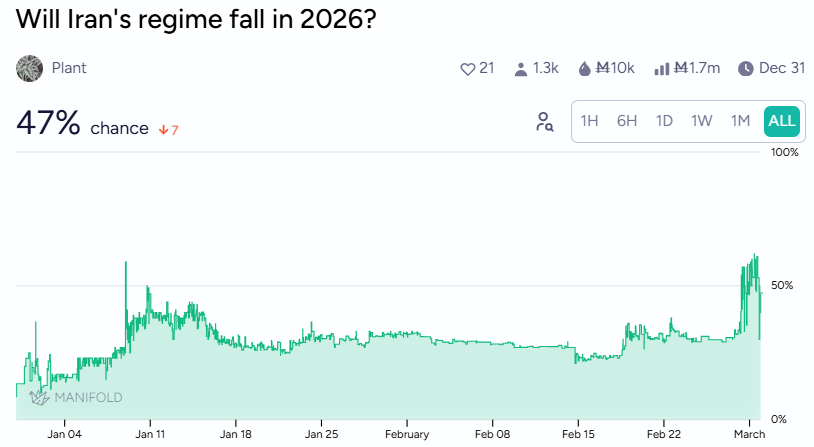
Manifold’s regime fall market has moved to 47%. In December it stood as a rounding error.
Celebrations and Condemnations
The reaction inside Iran was not unified, which is worth understanding before reaching for easy conclusions.
Celebrations broke out across Tehran, Isfahan, Karaj, Shiraz, Qazvin: cars honking, music playing, people gathering on rooftops as smoke rose over what had been the Supreme Leader’s compound.
The Iranian diaspora had been mobilising for weeks: 350,000 people in Toronto and another 350,000 in Los Angeles on February 14, Reza Pahlavi’s designated “global action day,” the largest Iranian diaspora mobilisations in history. Many had been explicitly calling for American military intervention. On Saturday they largely got what they asked for, and the celebrations in Westwood and across European cities reflected that.
Inside Iran, the picture was more complicated. Pro-regime crowds gathered in Tehran on Sunday morning. Mourners wept at the Imam Reza shrine in Mashhad. The government had killed thousands of protesters just six weeks ago, people who had taken to the streets over a collapsing rial and stayed for regime change, and the same security apparatus that carried that out remains intact. Basij forces reportedly opened fire on some celebrations. The internet blackout, near-total since January, means most Iranians are still receiving information through state channels or satellite feeds.
Internationally: Russia called the killing a “cynical murder.” China condemned an “undisguised assault on sovereignty” and noted, with some accuracy, that attacking “at the very moment diplomacy shows promise sends a dangerous message.” At least ten protesters were killed storming the US consulate in Karachi. The EU called it a “defining moment” and began working on “practical steps for de-escalation.”
The retaliation is already underway. Iran has hit US military bases across Bahrain, Qatar, Kuwait, the UAE, Jordan. Houthis resumed Red Sea operations. Larijani warned Gulf states that allowing their territory to be used for strikes made them “legitimate targets,” a notable thing to say to the countries hosting both your only mediator and, via the Strait, your only oil customer’s supply chain.
The IRGC Problem (And the Maryland One)
What is important to note is that killing Khamenei is not the same as regime change. The Council on Foreign Relations put it plainly: “The Islamic Revolutionary Guard Corps is the regime.”
The IRGC controls an estimated 30-40% of the Iranian economy: telecoms, energy, ports, significant portions of the black market. Khamenei was its ideological anchor; the mid-level commanders are its operating system. Many of them, in the Foreign Affairs framing, were less Khamenei’s subordinates than his partners. They have weapons caches, proxy networks, and no particular incentive to dissolve absent a political settlement. The most analytically likely successor scenario, according to some, isn’t a democratic transition. It’s an IRGC strongman consolidating power under the cover of wartime emergency, running a harder, more militarised version of what already existed.
Reza Pahlavi, 65, has lived in exile in Maryland for 48 years, longer than the Islamic Republic has existed (he left at 17, so make of that what you will in terms of governing preparation). He called Saturday a “humanitarian intervention” and urged Iranians to “resume protests as the Islamic Republic collapses.”
Traders now gives him a 39% chance of physically entering Iran by year’s end.
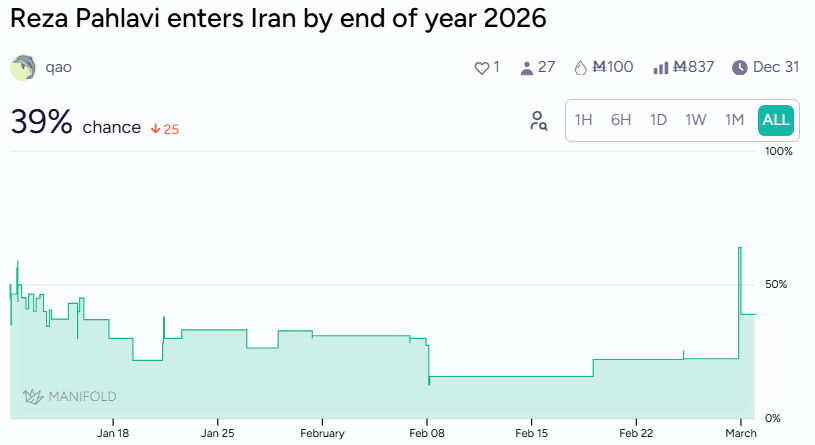
Perhaps the more revealing market is the conditional one: if the regime falls, does Pahlavi lead the new government a year later?

A supposedly 80% approval rating in diaspora polls doesn’t straightforwardly translate to governing a post-conflict state where the IRGC still controls the ports.

The succession process carries its own uncertainty. There have been exactly two Supreme Leaders in the Islamic Republic’s history: Khomeini, then Khamenei, who was notably underqualified for the role when elevated and had the constitution quietly amended to make him eligible. The Assembly of Experts must now convene under active bombardment to select a third. As Marco Rubio noted in January, “no one knows” who would take over. That assessment was made before the question became urgent.
Trump said the bombing campaign would continue “throughout the week or longer.” The stated objectives, destroying missile infrastructure, eliminating the nuclear program, producing regime change, are not all equally achievable from the air, and at least one former defense secretary has called the endgame “fuzzy.”


Whether this ends with a negotiated settlement, an IRGC-led successor state, or something genuinely new depends almost entirely on whether the security apparatus fractures. Signs of that at this point are murky. There is, however, a 47% market on whether it happens by December.
Happy Forecasting!
- Above the Fold