

Musk v. Altman, Brockman, OpenAI, and Microsoft
As closing arguments begin in Musk v. Altman, you might notice that the contours of the AI race have changed a lot in the last few years. About a decade ago, Elon Musk was the face of OpenAI and their biggest funder. Musk and Altman had organized OpenAI as a counterweight to Deepmind, after its acquisition by Google in 2015. By 2018, Musk had mostly disengaged from his involvement in the company, after a complicated internal struggle for leadership. It took another few years, though, for the animosity to reach a breaking point. After the launch of ChatGPT, and Microsoft’s subsequent investment in the company, Musk argues that he became convinced that the OpenAI leadership was out of alignment with its original goals as a non-profit. A more cynical interpretation is that Musk had already begun to launch his own private company, xAI, and was setting the groundwork for an attempt at competition.
Regardless of his motives, by early 2024, Musk had filed suit. This was re-filed, later in the year, with Microsoft added as a defendant. In November, he filed for an injunction to block OpenAI’s conversion to a public benefit corporation, but Judge Yvonne Rogers, who is currently presiding over Musk v. Altman, denied this injunction.
By late last year, the case had narrowed to two of its 26 original claims.
Breach of charitable trust: the for-profit restructuring of OpenAI violated the trust of Musk’s original $38 million in donations.
Unjust enrichment: OpenAI, Altman, and Brockman used Musk’s contributions for unauthorized commercial purposes which enriched them and their partners.
Last month, the trial began, with Musk seeking up to $150 billion in damages, which would go to OpenAI’s charitable arm, as well as the reversal of the conversion to a public benefit corporation and the removal of Altman and Brockman from leadership at OpenAI.
All these outcomes are still on the table.

Traders currently think there’s about a 1 in 3 chance of a full win by the defense, a 1 in 3 chance of Musk winning, within which a majority of scenarios would involve purely monetary relief of some kind, and a 1 in 3 chance of a settlement or some sort of procedural resolution.
The 12% chance of structural relief should give concern to OpenAI investors. Clawing back the conversion to a public benefit corporation would be unprecedented but would likely be quite painful for the company.
A lot of online commentary has treated a Musk win as kind of inevitable, and indeed, in 61% of scenarios, according to this market, there’s at least a settlement of some kind. But that settled amount could be quite low. Traders on a market with prop bets on the trial think that there’s only a 29% chance that the total damages awarded could exceed $10 billion, which at least to me weakly implies that were a settlement to be reached, it would likely be lower than this total.

Forecasters were caught off guard by Ilya testifying in the trial, that prop traded at around 30% until the announcement was made that he would in fact be testifying. Traders here also think that a licensing restriction, nullifying OpenAI’s exclusive licensing agreement with Microsoft, is a more likely structural remedy than undoing the for-profit conversion or ousting Altman or Brockman. So far, Musk has been remarkably restrained on X, and hasn’t been held in contempt of court for posting, but there’s always a chance, with traders still giving 12% odds to such an occurrence before the trial is complete.
OpenAI v. Everyone
OpenAI’s legal troubles, across the board, are a millstone around their neck for the foreseeable future. Anthropic’s battles with the Trump administration have sort of fallen by the wayside, with the DoD now back in engagement with the company despite their “supply chain risk” dispute.
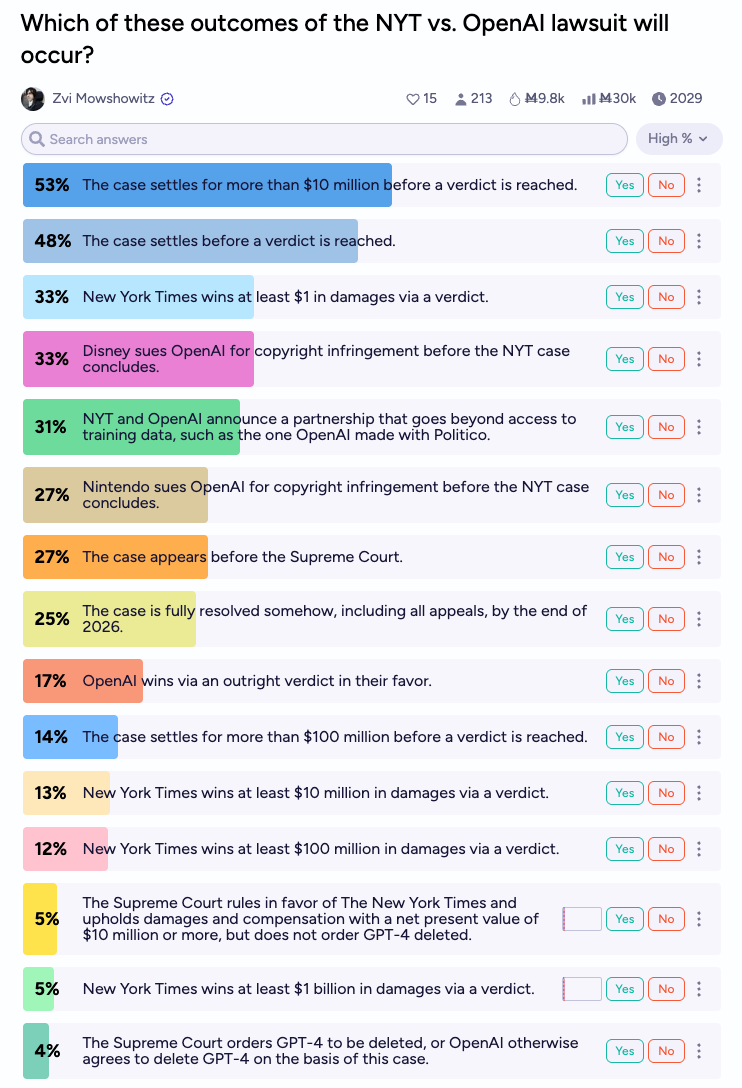
It’s easy to forget, but the trial between the New York Times and OpenAI/Microsoft still promises fireworks. Markets have them as favorites to win (or at least settle in their favor):

The case has dragged on in pre-trial due to a number of consolidations, but traders think it’ll be a blockbuster, with more than a 1 in 4 chance of getting up to the supreme court!

Reading through the prop bet market’s strikes provides a little window into the Overton window of 2024. It’s almost inconceivable to imagine the court “ordering GPT-4 to be deleted” whatever that would mean at this point. Also, the idea of $10 or $100 million being reasonable bars to set for “large amount of money to OpenAI” may have made sense in early 2024 but now seem laughably small.
Another trial, which briefly made the headlines, is the most prominent of several wrongful-death lawsuits filed in California against OpenAI by the Social Media Victims Law Center. The parents of 23-year old Zane Shamblin have brought multiple claims against OpenAI for the wrongful death of their son.

It would be great to have more forecasters take a look at this new market, as wrongful death suits have the potential to dramatically shift the way AI is deployed among laypeople, especially with certain AI companies positioning themselves as deploying primarily enterprise models and others developing apps for the median global citizen.
Renting Compute
This trial has also made some unusual bedfellows. As Intelligencer and others have reported, xAI (which has plenty of compute but not enough users) has loaned its Colossus 1 data center to Anthropic (which has plenty of users but never enough compute). Pertinently, Colossus 1, which has a hodgepodge of different GPU clusters within it rather than a single, unified architecture , is better for inference than training workloads (serving AI models rather than shaping them), which is precisely where Anthropic is currently straining at its buttons. But it’s hard not to see this move as a middle finger to their mutual rival despite it also making business sense on a couple levels.

Forecasters had been mixed on the odds of this happening, and in fact, earlier in the year, it looked quite unlikely, with xAI posturing as though they were going to go all-in on competing as a frontier AI lab. After their merger with SpaceX was announced in February, however, the market shifted dramatically north.
With certain markets, I actually think the creator deserves a lot of credit for writing a question well in advance of that question becoming highly relevant. Manifold user RS also has markets on whether OpenAI or Meta will rent compute to external customers by the end of the year. OpenAI is trading at 11% (I guess there’s always a chance of some sort of compute arbitrage even among the leaders) but the market on Meta, which is trading at 38%, has woefully few traders and is probably your best bet at fading Meta’s near-term chances.

If Meta starts renting out their compute before the end of year, I think it’s safe to say that that would be a negative signal towards their success at staying afloat in the race.
Roundup
Pope Leo’s first encyclical, now all-but-confirmed to be about AI, will come out on Friday. I’m excited to read the document, Pope Francis’s encyclicals were famously bangers, from Laudato si’ on consumerism and climate change to Fratelli tutti on global consensus and camaraderie.

You can trade on whether it’ll release on time, mention human extinction or deepfakes, discuss if an AI can possess a soul, and name an AI exec (I think this option is slightly underpriced at 3% but I can’t trade on my own market: free alpha here).
You can also trade on whether Pope Leo will mention prediction markets this year:

Also, Trump and Xi appeared to have shaken hands in their recent face-to-face meeting for 14.5 seconds, just under the highest bucket. Too short!

Happy Forecasting!
-Above the Fold