

The IPO Race
Amidst the recent turmoil between the federal government, Anthropic, and its rivals, I’ve seen a number of commentators point out something interesting. The private ownership of Anthropic and OpenAI means that far fewer Americans have a direct stake in their success than in other firms of their size and centrality to the economy.
If the Pentagon had attempted to label, say, Walmart or Exxon Mobil a supply chain risk, then the tens or hundreds of millions of Americans with direct stakes in the stocks of those companies would feel the effects, regardless of their personal affinities towards them.
This might change soon. Anthropic, OpenAI, and other AI companies are rushing to IPO as soon as this year. They will skyrocket into the top echelon of publicly traded companies if and when this happens. It wasn’t always obvious that they’d choose to press for a fast timeline. With their ability to attract the largest private investment rounds in history, it wasn’t clear that going public was as necessary as for other capital-intensive private companies.
But, with secondary markets clamoring for access to shares, and capital expenditures for hyperscalers rising just as precipitously as revenue, IPOs in the next 12 months are likely. Internal pressure from employees with equity and early VCs won’t hurt. Manifold traders are quite interested in the topic as well…

For a while, the race to IPO for American private AI firms looked like more of a three-horse race, but the merger of xAI and SpaceX put that to rest, with SpaceX/xAI now very likely to go public within the next few months.

While many observers might fairly think that xAI isn’t really in the same league as the other two companies, they did in fact raise money earlier this year at about half the valuation of Anthropic (about $250 billion). And now, packaged with SpaceX, they might be more valuable than both.
But, ummmm, it’s not clear how long this will hold.
Valuations
Just like the intelligence of their models, their number of employees, their revenue, and the number of protestors outside their offices, the valuations of these companies (check out MNX) seem to be doubling every few months.
Epoch has had great success drawing straight lines on log-plots, and they called Anthropic surpassing OpenAI’s revenue in early 2026.
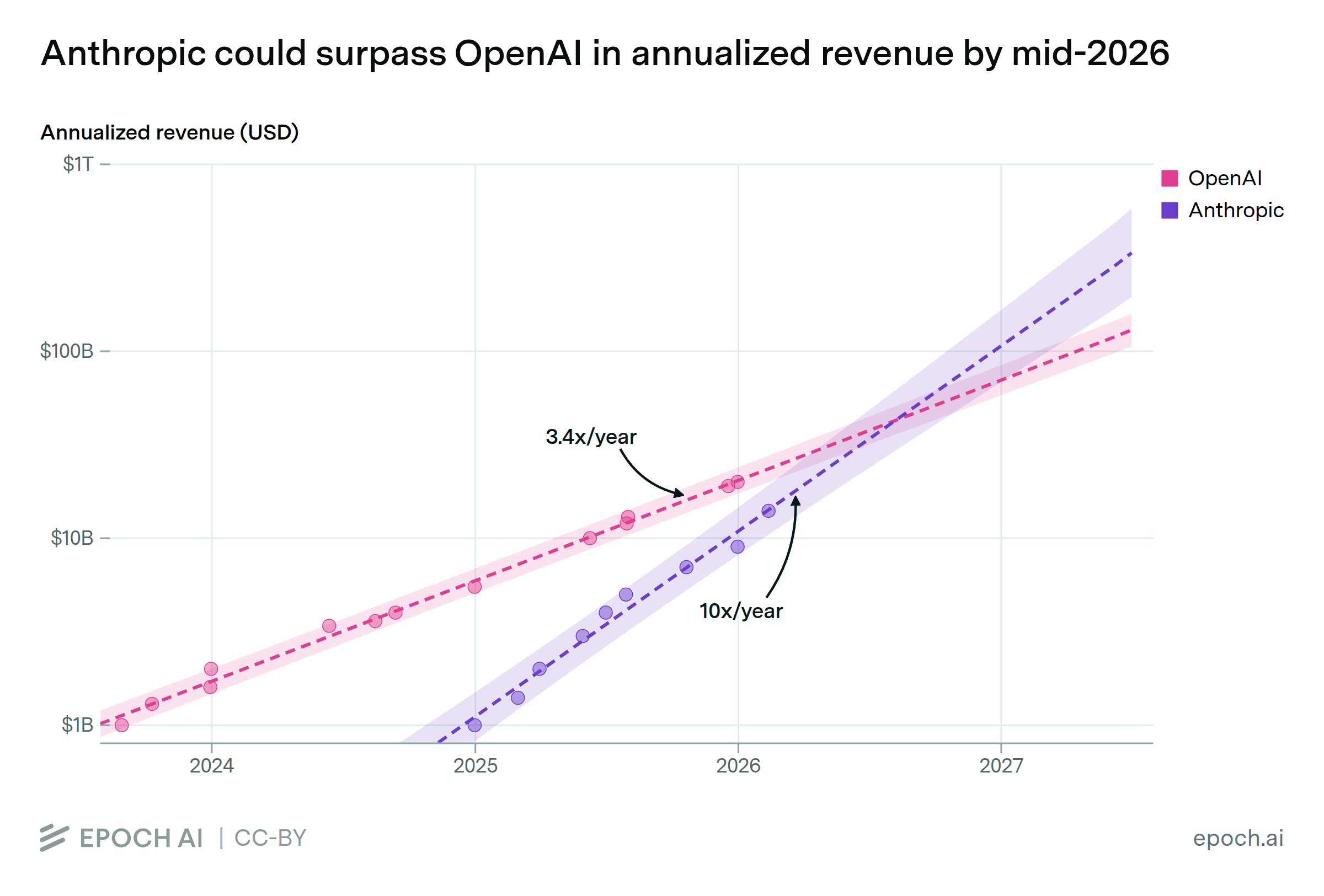

With their latest run-rate revenue forecast of $30 billion a few days ago, this market resolved YES, sending markets on whether Anthropic would flip OpenAI skyrocketing.

The market on combined EOY revenue for America’s three private AI companies had to create some new buckets in the last week, as the top bound was around $150 billion, which now looks to be below the median trader’s expectations. Two Twitter users (at least one of whom is a top Manifold trader, I believe) made an over/under bet at $90 billion on just Anthropic’s run-rate revenue, and we now have a market on it:


Much of the recent bullishness around Anthropic has been the disclosure of their Mythos model. Enough ink has been spilled about Project Glasswing and Mythos’s emergent ability to spot zero-day vulnerabilities, but nevertheless…
It’s a story that at the same time is extremely urgent for the public and policymakers while being slightly overhyped in breathless reporting. As keen observers have by now pointed out, previous models like Opus 4.6 and GPT-5.4 likely have abilities nearing this as well, with Mythos representing a continued climb up that particular capability curve, rather than a discontinuous jump. Skeptics have noticed that the amount of cost and compute thrown at discovering individual vulnerabilities during testing ranged up into the ballpark of tens of thousands of dollars, and mused that Opus 4.6, given that amount of time and energy, could probably find a similar vulnerability.
Obviously, without public access to the models, it’s hard to say. No one seriously doubts that Mythos is a highly capable model, and traders in fact think that sooner or later, Anthropic will release it to the public in some form:

And when it does, it will likely come in at about 10x the cost of other frontier models on a per-token basis.

And even if we don’t get Mythos, we’ll likely have access to something with similar capabilities within the next few months:

Bubble
Alternatively, many online and even some on Manifold hold a very different set of beliefs about how AI will play out over this year. While it’s hard to operationalize a market on what an AI bubble “popping” would look like, one creator has given it a good try:

The criteria for this market read:
This could manifest in many different ways:
- Sudden drop of the NQINTEL or S&P500 indexes
- Halt of capital expenditure and/or VC investment in AI
- Private AI companies (such as OAI, xAI, Anthropic, etc.) raising at substantially lower valuations than previous rounds, defaulting or shutting down.
- Governments / big enterprises moving down AI in their priority lists.
These events need to be widely reported and referred to as an AI crash or similar by trusted news sources such as Bloomberg, NY Times, FT, Reuters, AP, etc.
Other reasons for a stock market crash or economic slowdown (tariffs, wars, etc.) will not count.
Alternatively, another creator has simply made a market on which AI companies will drop dramatically from their peak this year. Apart from Oracle, traders think this is unlikely for most firms that are heavily leveraged in the AI boom.

Notably, the odds for a general recession—potentially caused by, umm, overseas conflict—are much higher than a crash localized to the AI sector:

Roundup
Not just the AI companies might go public this year. You can bet on Discord, Anduril, Skims, and Jersey Mikes too!

Is Mythos really AGI if it can’t speedrun Minecraft?

And we probably won’t know what Ilya has been up to by July:

Happy Forecasting!
-Above the Fold