

A Christmas Wager
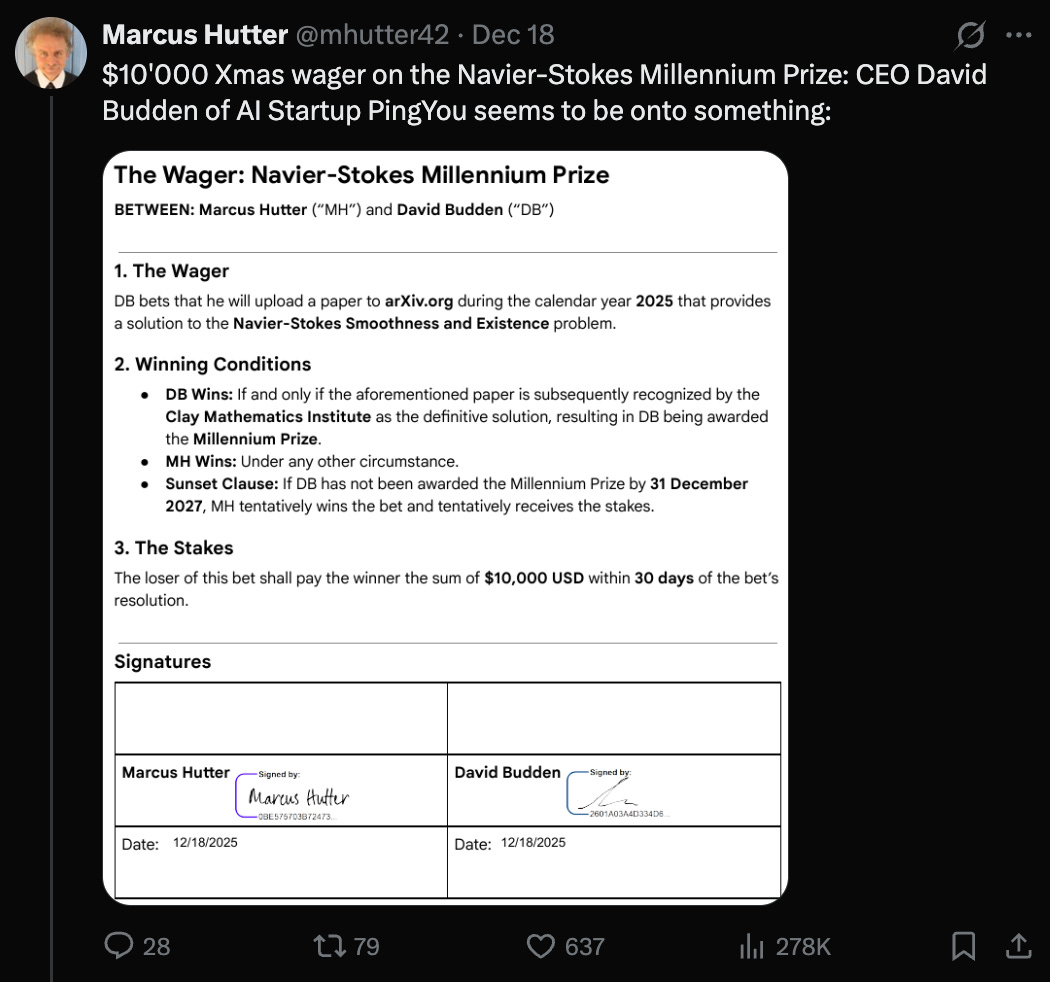
Late last Thursday, DeepMind researcher Marcus Hutter announced he had made a bet with his former colleague, David Budden. Budden was coming out of stealth to announce his startup PingYou, and claimed to have—or be working on—a solution to the Navier–Stokes existence and smoothness problem.
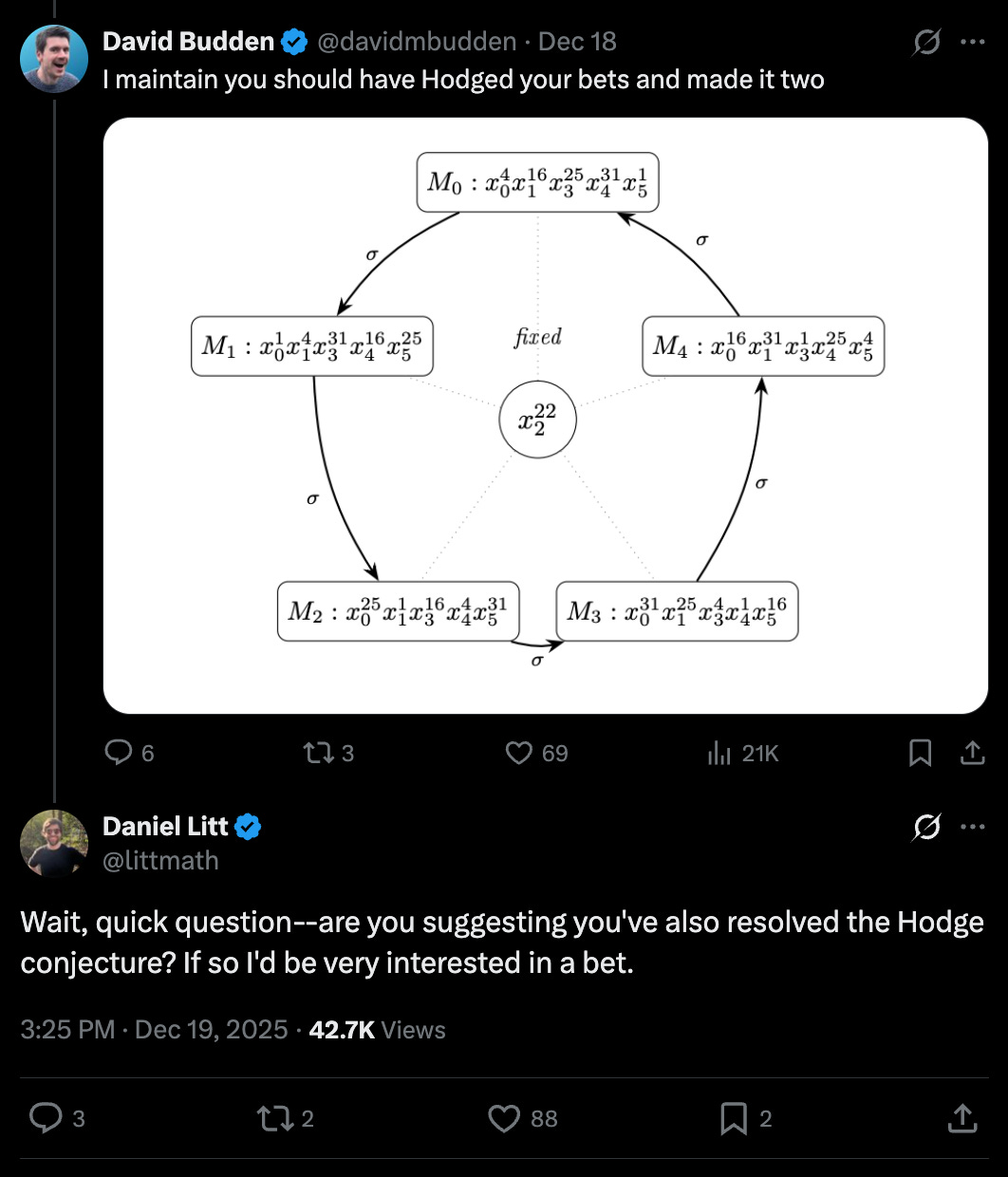
The next day, lower down in the thread, math professor Daniel Litt made an additional bet, to the tune of $25k, that Budden had not solved the Hodge conjecture as well.
Both of these bets have a pretty strict resolution criterion: the Clay Institute, which awards the million dollar prizes for the Millennium Problems, has to recognize Budden’s solutions.
Pretty soon after this, the whole situation went fairly viral on Twitter. People were discussing AI capabilities, LLM sycophancy, the credentials of the participants of the bets, the possibility of the Millennium Prizes being solved, and the bravery of those who had taken bets.
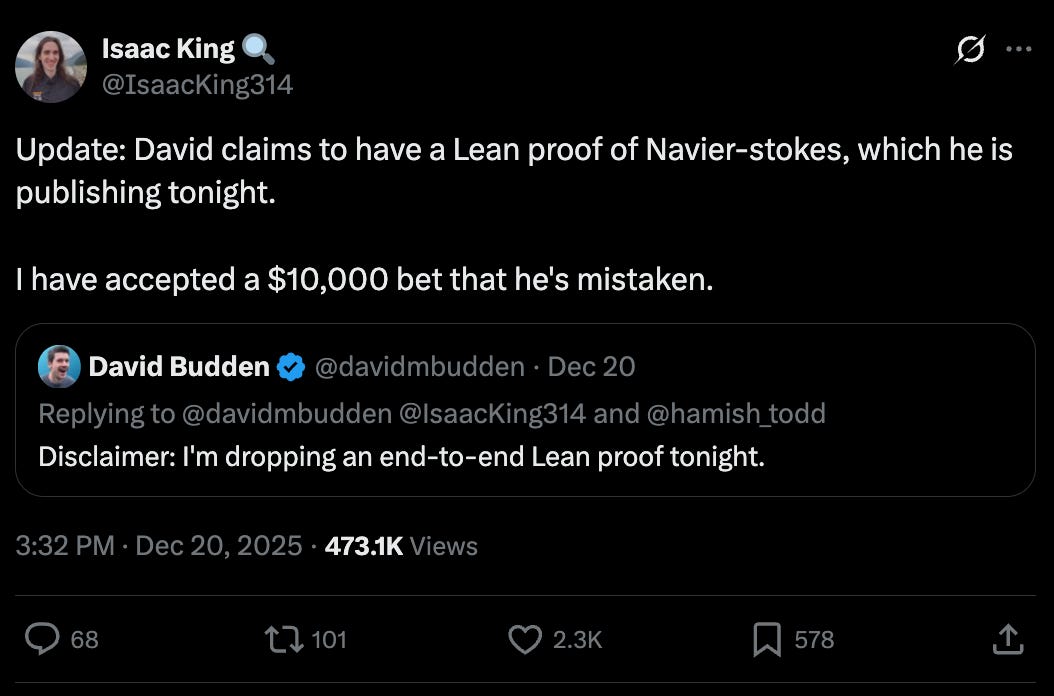
One of Manifold’s own, Isaac King, accepted Budden’s third bet on the matter over the weekend, and Budden claimed to be ready to drop a Lean proof.
Budden’s credentials were enough to raise some uncertainty here. DeepMind has a history of some pretty impressive scientific achievements, after all. Demis Hassabis and John Jumper are still fairly fresh of their 2024 Nobel prize in chemistry for work done at DeepMind. It’s not entirely inconceivable that someone left the company, made an AI startup on formalizing or solving challenging math problems, and quickly obtained some results. If Navier-Stokes was going to get solved in the year 2026, I think the modal scenario is probably “former DeepMind engineers making a startup to pursue moonshot math research and win the Millennium Prize.”

And Budden’s willingness to make 1:1 bets on the matter was certainly evidence of strong conviction. However, I think it’s good to have some context on what Navier-Stokes and the Hodge conjecture are, and what kind of incredible leap in capabilities it would take to solve these problems.
The Millennium Prize Problems
Back in 2000, the Clay Mathematics Institute pledged $1 million to the first to solve each of the following 7 prizes:
Poincaré conjecture(solved back in 2003 by Grigori Perelman)
Extremely naively from base rates, we should expect about one to be solved every 2-3 decades. However, a lot of people with strong beliefs in AI capabilities tend to think that a few of these problems might be uncovered by a super-intelligent or even just narrowly intelligent AI system in the nearer term. Timeline forecasts on Metaculus, for instance, give median forecasts several decades out, but have a moderately-sized peak over the next few years to account for this possibility.
This is the Clay Institute’s statement of the Navier-Stokes Problem that Budden has made two bets claiming to have a solution for:
Prove or give a counter-example of the following statement:
In three space dimensions and time, given an initial velocity field, there exists a vector velocity and a scalar pressure field, which are both smooth and globally defined, that solve the Navier–Stokes equations.
Navier-Stokes has pretty important ramifications for understanding fluids, turbulence, and many related areas of physics. The Hodge conjecture, which Budden has another bet on, is a little outside my personal understanding of mathematics, but simplistically can be described as proposing that complex geometric shapes can be constructed from simpler geometric pieces.
In any case, if any of these were solved, it would instantly slingshot the solver into global fame and fortune.
What do the markets think?
The markets around these bets are wholly unconvinced. A large volume of new traders have signed up to bet in Budden’s favor, whereas Manifold whales are staking out large limit orders at 95%. Budden himself signed up to Manifold to bet in his own favor. Early on, when it appeared that Budden might be heading a stealth startup with several AI researchers who had been working on Navier-Stokes for months and now had results to unveil, the markets were slightly more bullish in his favor. But after it came out that he was potentially still wrapping up the proofs, and was actively iterating with an AI in doing so, the markets moved rapidly against him.


To some, these dynamics seem to call back to the LK-99 drama from a few years ago, which drove a lot of engagement from new users and techno-optimists.

I don’t personally think the two situations are quite as similar as Daniel Litt does. For one, with the LK-99 drama, many materials scientists and physicists were interested in the finding, actively engaged in physical replication attempts, and working on computer simulations to help cast light on the Korean group’s results. And while many expressed skepticism that the group’s results were real, there was real uncertainty around the findings that many thought was due to the lack of experience of the researchers, the impurity of the material, or the complexity of nature.
In this case, the mathematicians that are taking this most seriously are those attempting to bet against Budden, not corroborate his findings.
Manifold seems to think that it’s likely that his Lean formalization of the proof will be incomplete or contain an error in formalization that makes it inadmissible as a solution from the Clay Institute’s perspective.
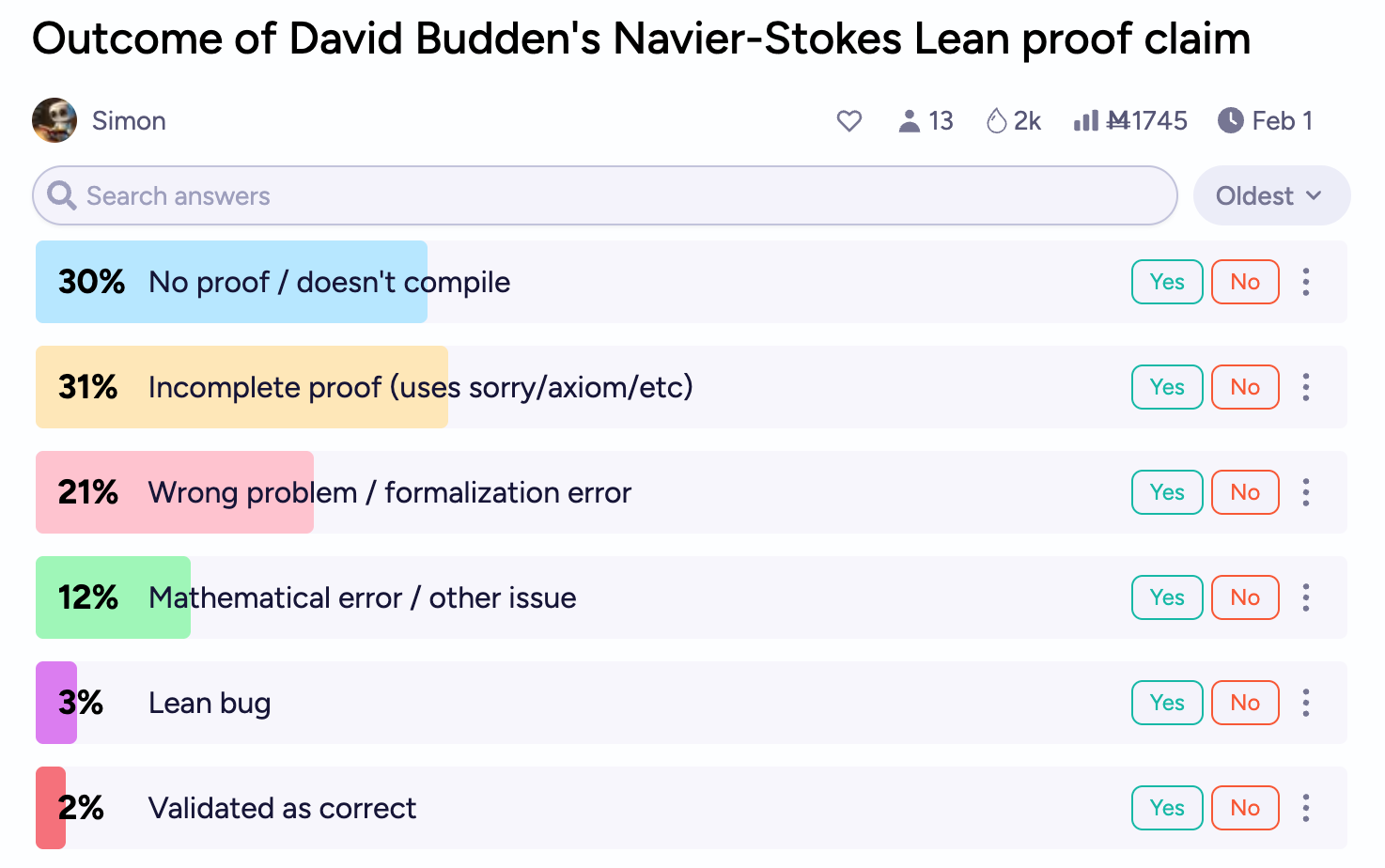
A big part of traders’ skepticism has come from the realization that Budden did not appear to have some sort of ready-to-submit solution to Navier-Stokes or the Hodge Conjecture, as a result of months of work from his startup. Rather, he was dropping half-completed files with time to go before the deadlines specified by his bets.

Some observers have been concerned for his health. Others have been more enthusiastic, claiming that he is serious and enthusiastic about these problems. Budden has made at least three (or four?) 5-figure-sum public bets at this point, and there’s a market on whether he will ultimately pay out:

AI capabilities vis-a-vis the Millennium Problems
For the record, Manifold traders do indeed seem to think that Navier-Stokes is the most likely of the Millennium Prize Problems to fall.

What’s more, they also seem to agree that AI labs have a better shot at solving it than traditional math departments!

Another market gives a 1 in 4 chance of a Millennium Prize Problem being cracked by AI within the next 3 years!

And conversely, another market thinks there’s under a 2 in 3 chance that any human manages to solve any of the remaining Millennium Problems without considerable reliance on AI means:

Ultimately, traders just do not think that this solution is likely to come from the current claimant on Twitter. Although a 2-5% chance is not zero, I think that might be reflective of prediction market discount rates more so than genuine uncertainty on the part of the market.
Whatever the outcome, I believe that (1) public figures making bets on their beliefs is a great thing for public epistemics, and (2) that this saga will ultimately result in a lot of people on Twitter learning about several unsolved problems in mathematics. Seems good.
And if you have strong opinions about it, you should go place a bet on Manifold to register your beliefs.
Happy forecasting!
-Above the Fold
Interesting! For a different perspective, a group of AI experts and Superforecasters on the Forecasting Research Institute's Longitudinal Expert AI Panel (LEAP) currently predicts a 20% probability that AI will solve or substantially assist in solving a Millennium Prize Problem in mathematics by 2030.
https://leap.forecastingresearch.org/reports/wave2