

The 2026 FIFA World Cup starts in four months. Assuming it happens.
That qualifier might sound dramatic, but markets give 52% odds that FIFA cancels matches in Jalisco due to cartel violence, and 18% that at least one US ally boycotts the American portion of the tournament.


Whether all three host nations actually stage their assigned games is a legitimate question rather than the usual pre-tournament anxiety about hotel availability.
The football itself should be good. Spain leads betting at roughly 17%, England at 13%, France at 12%. The expansion from 32 to 48 teams means more matches and arguably more uncertainty, though markets give an 80% chance a previous winner takes it. Either history matters or traders seemingly lack imagination :(


Japan qualified first among non-host nations and sits at 1.2% despite beating both Germany and Spain in 2022 (while their odds of playing in the quarterfinals are more respectable, at 15%).


Markets price a non-European or South American finalist at 14%.

The US benefits from home advantage and drew a favourable group. Markets give them a stronger 75% chance to advance from the group stage but essentially zero chance of winning the tournament.

Mexico sits at similar odds, with Canada being the longest shot out of the three.
Golden boot odds favour Mbappé, followed by Kane. There’s an 90% chance someone scores 6 or more goals, 65% for 7 or more.


The scoring race matters beyond tournament MVP considerations now. It’s become the primary metric for Ballon d’Or voting in a world where nobody quite dominates the way Messi and Ronaldo did for nearly two decades.
FIFA is also introducing blue and purple cards. Blue for tactical fouls, purple for dissent. Players get 10 minutes off for either. Markets are sceptical about consistent enforcement, which seems reasonable given FIFA’s track record on following its own rules.

How to Give a Peace Prize
In December, FIFA President Gianni Infantino created a peace prize specifically to give it to Donald Trump at the World Cup draw (allegedly, of course, although markets might have been a bit more straightforward with their thinking).

Interestingly enough (not really), traders agree that FIFA loved Trump so much that they will likely honour him by not handing the prize to a new winner this year. Although, hopefully, we will get to see Trump win it again (a possibility standing at 3%)!

The trophy was gold-plated, roughly the size of the actual World Cup trophy. Trump’s team allegedly insisted on this sizing. The certificate praised Trump for “bringing peace” to the world. Trump called it “one of the great honours of my life.”
Three weeks later, US forces seized Venezuelan President Nicolás Maduro. Trump has since threatened to annex Greenland, imposed travel bans on qualified World Cup teams including Senegal, Ivory Coast, Iran, and Haiti, and overseen immigration crackdowns that sparked mass protests in Minneapolis and other US cities.
Former FIFA President Sepp Blatter backed calls for fans to boycott US-hosted matches. “For the fans, there’s only one piece of advice: stay away from the USA!” Mark Pieth, the Swiss attorney who chaired FIFA reform oversight a decade ago, said the same thing.
The peace prize sparked formal ethics complaints. A London-based rights group argued Infantino violated FIFA’s political neutrality mandate. FIFA’s response was to set up an office in Trump Tower in July and have Infantino show up to Trump’s Board of Peace meeting last week wearing a red “USA” hat.
Trump has kept the actual FIFA Club World Cup trophy as an Oval Office decoration since Infantino gave it to him in March. Chelsea had to hoist a replica when they won.
Infantino defended the decision, saying that Trump “objectively deserves it” for being “instrumental in resolving conflicts and saving thousands of lives.” He added that FIFA should “never ban any country from playing football because of the acts of their political leaders,” which is an interesting position given Russia’s ongoing suspension for invading Ukraine.
The tournament runs June 11 to July 19. The final is at MetLife Stadium in New Jersey. Ticket prices sparked outrage: hundreds of dollars per match. Blatter called it a “slot machine” operation focused on “money, money, money,” which is rich coming from the man who ran FIFA during its peak corruption era but isn’t wrong.
The Boycott Question
Over 150,000 people in the Netherlands signed a petition calling for their team to withdraw. Germany’s football federation vice president said it’s time to “seriously consider” boycotting, comparing the situation to Olympic boycotts during the Cold War.
Markets give 9% odds that a NATO member boycotts the World Cup.

The actual federations have been more cautious. Germany, France, and the Netherlands all said they’re not planning to boycott.
UK MPs called for the US team itself to be excluded, citing similar reasoning to Russia’s ban: undermining the rules-based international order. FIFA’s contract allows them to “cancel, reschedule or relocate one or more matches (or the entire FIFA World Cup 26) for any reason” including “health, safety or security concerns.” Markets give 30% odds that at least one US WC game is moved because of Trump-adjacent politics, fair odds considering the fact that a clear contractual pathway exists.

Iran threatened to boycott the December draw after four of nine visa applications for their delegation were rejected. They eventually sent a smaller group. Teams from Haiti face similar restrictions. Markets are thin on whether Iran gets formally banned (or whether they withdraw themselves), but there’s precedent.

February in the Premier League
Arsenal are 5 points clear at the top of the Premier League. Manchester City have a game in hand. It’s mid-February.
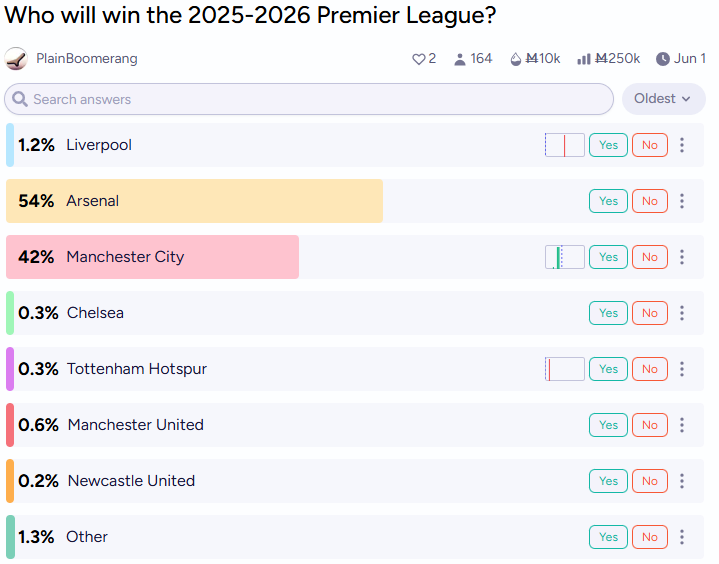
Markets give Arsenal 54% odds of winning the title, City 42%. That 12-point gap feels smaller than 5 points on the table would suggest. Traders have seen this before. Twice.
In 2022-23, Arsenal were 5 points clear in February with 12 games left. They dropped an astonishing 21 points from that position. City won the title. In 2023-24, Arsenal led through February before City’s late surge. Liverpool actually won last year, but Arsenal and City both finished ahead of them in the “February onwards” table that seems to matter.
The pattern, which Arsenal fans seem acquainted with at this point, is specific. Arsenal build leads through autumn when City are rotating through Champions League fixtures. Come February, City traditionally click into gear while Arsenal start dropping points to teams who’ve figured out how to sit deep and counter. Brentford last week: 1-1 after taking the lead. Wolves on Wednesday: 2-2 after being 2-0 up.
City’s recent form tells the story. Comeback win at Liverpool: 2-1, Haaland penalty in stoppage time after going behind to a Szoboszlai free kick that could have made it 9 points to Arsenal. Then 3-0 against Fulham.
The fixture markets have long been pricing as decisive pricing as decisive: April 18 at the Etihad. Arsenal travel to Manchester with presumably a smaller lead. City with momentum and home advantage. City with the knowledge that Arsenal have historically crumbled in this exact situation.
Haaland’s drought is the subplot everyone’s watching. Only 3 goals in 13 appearances in 2026. Just penalties from open play. His overall season numbers remain strong: 25 goals in his first 23 games, but the February barren spell is new.
This matters for the Ballon d’Or odds more than you’d think.

Haaland sits at 4%, down from a high of 20%, and Mbappé at 21%. The Messi-Ronaldo era set expectations so absurdly high that everyone’s still adjusting to what normal excellence looks like. Those two scored 50+ goals per season like it was routine. They won 13 Ballon d’Ors between them across 15 years. The award was basically a binary choice between two players having seasons that would have been all-time great for anyone else.
Mbappé’s 21% is largely contingent on France having a deep World Cup run.
Elsewhere: Tottenham are 16th, five points above relegation, having just appointed Igor Tudor as interim manager after sacking Thomas Frank eight months into his tenure. Eight managerial changes this season so far. Manchester United sit 4th under interim boss Michael Carrick after Ruben Amorim’s departure. The managerial carousel spins while Arsenal and City play out their annual ritual.
Five points with a game in hand. Fourteen fixtures remaining. Arsenal have been here before. Markets remember even if the table doesn’t show it yet.
Happy Forecasting!
- Above the Fold
Are you by any chance confounding "you remember" with "markets remember"? I'm not sure I agree that the 12 ppl difference is really less than the 5 pts difference on the table with 10 games to play, indeed, with City a game in hand, and the two playing each other in Manchester, it feels like 12 pp is a _bigger_ difference than naive inference from the table!